 About
About
 Writing
 Canon
Canon
 Subscribe
 Work With Us
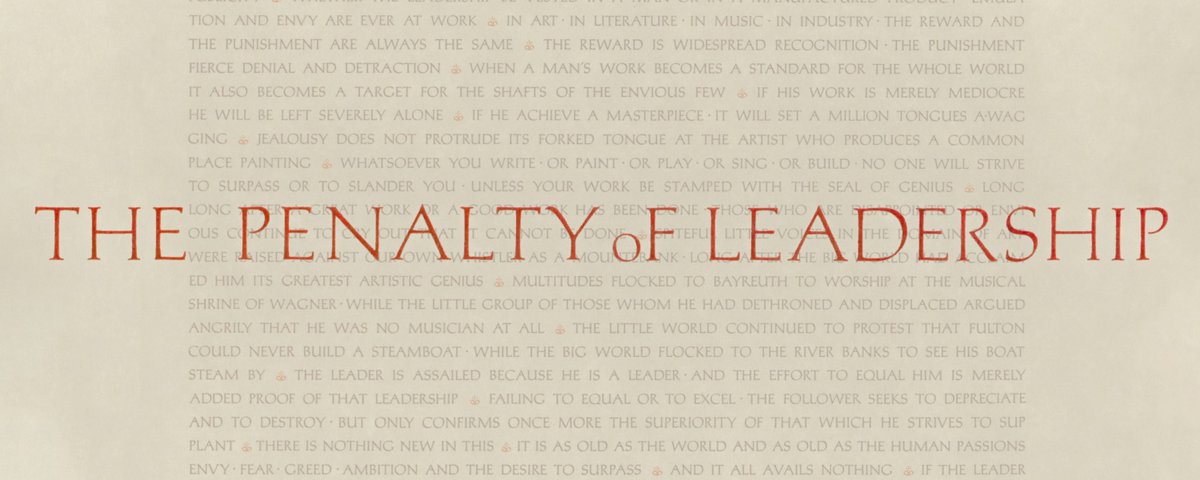
In 1915, Cadillac ran a single page in the Saturday Evening Post, “The Penalty of Leadership,” a meditation on what it costs to be first after competitors mocked its decision to lead with the V8. The company reprinted it for thirty years. People still hang it in their offices today.
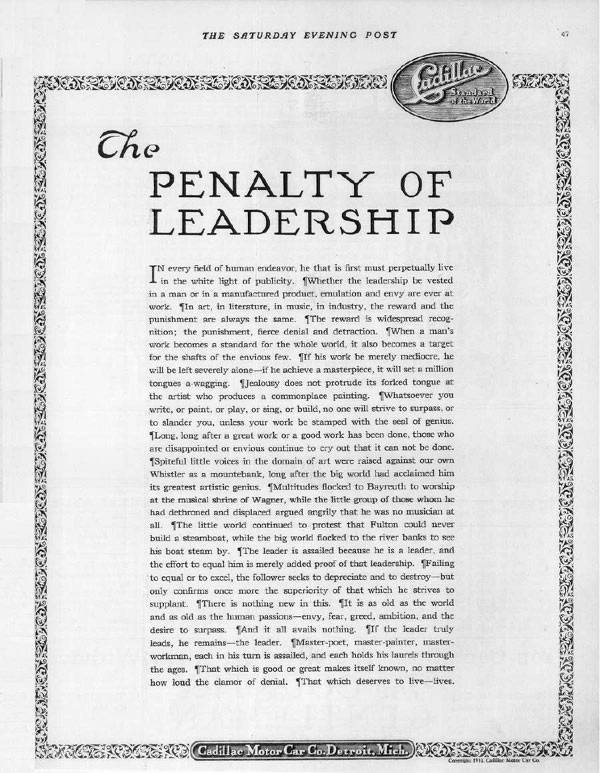
They hang it because they’re hungry for it. People want to be a patron of a company that believes something specific enough to say it in public, and maybe even to be the kind of leader the ad describes. That hunger is what this essay is about. There is a kind of corporate writing that used to be possible, then disappeared, and whose return is now necessary.
The best way I can describe this style of writing is articulation: the act of putting into language what a company already knows about itself. The person who built the thing wrote the words, and the words were proof of the conviction that was building the thing.
In 1945, Edwin Land testified before Congress that “the business of the future will be a scientific, social and economic unit,” organized around a vision of what science could do for human life. When a shareholder once pressed him on profitability, he replied: “The bottom line is in heaven.” Polaroid was profitable—extraordinarily so, for most of its life. Land’s point was that profit is downstream of something that can’t be reduced to a number, and that making the number the organizing principle causes you to lose the thread that produces it. In Polaroid’s 1978 annual report, he wrote that he had “long aspired to make our Company a noble prototype of industry: penetrating in science, reliable in engineering, creative in aesthetics and wholesomely prosperous in economics.”
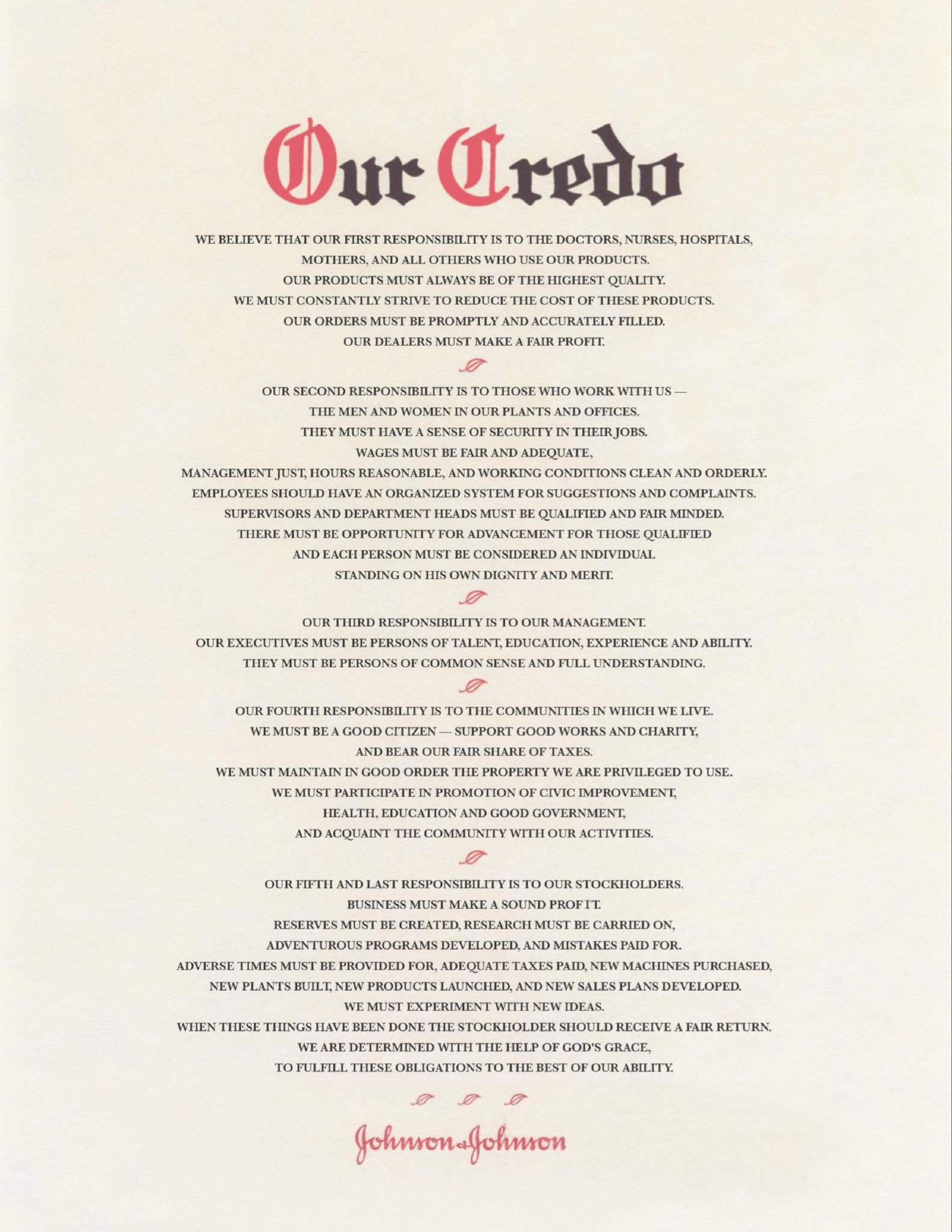
You can see the same conviction in Robert Wood Johnson’s Credo, written on his personal notepad in 1943, and eventually printed a single page declaring who J&J serves and in what order, customers first and shareholders last. Or in Thomas Watson Jr.’s A Business and Its Beliefs, published in 1963 and distributed internally so that everyone at IBM carried the same convictions. Watson understood that shared belief is what makes an organization capable of anything.
What these documents share is that they move outward to inward, from the customer to the colleague, and in each case a single person is thinking in public about what they believe and why.
Several forces, compounding over sixty years, eliminated this genre. Each one separated the founder from the writing. By the end, no individual human was accountable for a company’s words.
Bill Bernbach’s Creative Revolution in the 1960s elevated advertising to an art form, introducing the specialist whose job was to make the message land rather than to hold the belief that generated it. By the 1980s, communication was a regular corporate function. The company’s words were now an organization’s deliverables, smoothed across competing interests.
Then came the lawyers. Sarbanes-Oxley in 2002 turned the CEO letter into a committee document reviewed by Legal, Compliance, IR, and the board. The person who held the belief couldn’t sign the document. The person who signed the document didn’t hold the belief.
Economist Karl Polanyi might call this “disembeddedness”: the condition of economic life abstracted away from the communities, obligations, and shared beliefs that once gave it meaning. Pre-industrial commerce was embedded: the merchant talked directly to his community, knew his customers by name, and was held to account by the people who could see what he actually did. The quintessential example is the Ottoman bazaar, where merchants would be aware of whether their neighboring merchant had made any opening sales for the day, and if they had not, would send customers over to their neighbors.
The modern corporation has no such audience or accountability. Even “shareholders” are an abstraction of a single idea: profit. As companies abstracted away from the communities they served, their communication followed. The audience became “the market.”
Around the time I started Native, Lulu Cheng Meservey published Go Direct. Her argument was that founders should own their distribution, build their own platforms, and write their own narratives. The manifesto got a lot of attention, especially given how hostile the press had become toward tech. Who could disagree? But Go Direct caught on partly because it imposed no penalty.
Rostra might hold strong values, but the version of the manifesto that founders heard was that they should say more on social media, not that they should believe anything in particular. The information environment has gotten worse since founders took that advice. The channel problem got solved, but there is nothing rooting it upstream.
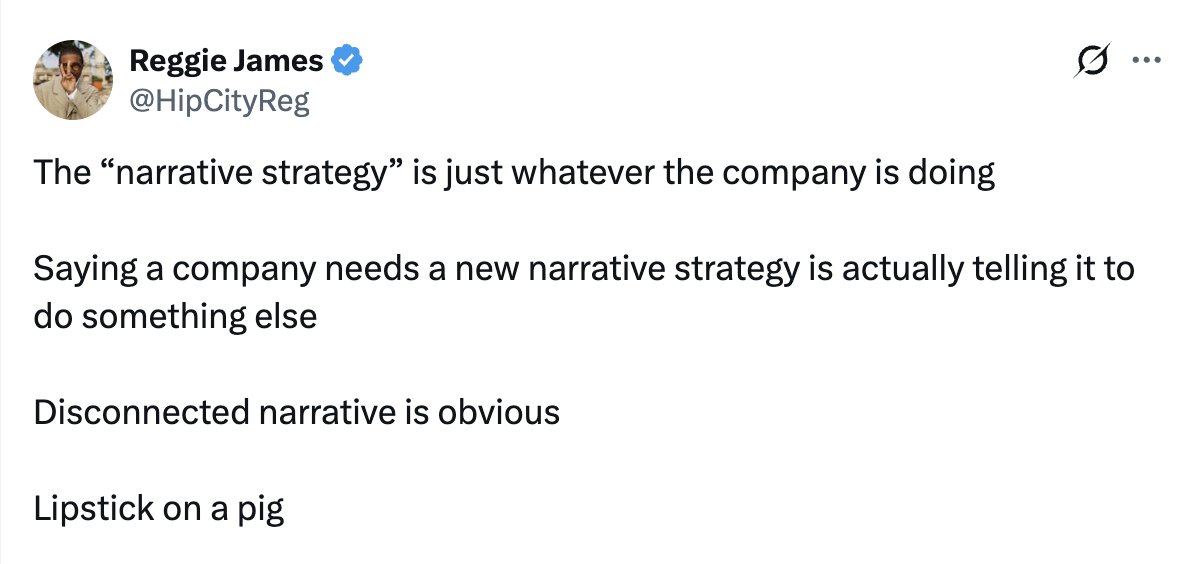
Some younger founders, noticing that safety was producing invisibility, overcorrected into ragebait and manufactured controversy as a substitute for conviction. Both are disembedded. As Reggie James put it: “Disconnected narrative is obvious. Lipstick on a pig.” There’s a belief problem, not a channel problem.
The problem is only becoming more urgent, for two reasons. The first is that distribution is free and attention is scarce. Content marketing and LinkedIn thought leadership are trending toward infinity. In that environment, saying something specific is an act of selection. Yvon Chouinard built Patagonia on the logic that belief comes first, articulation second, and returns third, as a consequence of the first two being real.
The second is AI. Every company can now generate infinite content that sounds professional and says nothing. Dario Amodei’s “Machines of Loving Grace” works not because it’s technically polished but because it could be wrong in specific, committed ways that reveal what he actually thinks. What a language model cannot do is write from inside a real community to people who have genuine stakes in whether the belief holds.
Go Direct became a movement because it asked nothing of the people who adopted it. The advice was correct as far as it went, but it was adopted so widely because it carried no penalty.
Writing with conviction and vulnerability means being wrong in public. These are real costs, and for sixty years the rational response was to avoid them.
What’s changed is the calculation, not the penalty. AI is flooding every channel with writing that is competent, professional, and entirely without conviction. The noise is loud enough now that the careful statement makes you invisible. The penalty of caution has gotten more expensive than the penalty of leadership, and the companies that figure that out first are the ones that will matter.