 About
About
 Writing
 Canon
Canon
 Subscribe
 Work With Us
A love letter to the annual report. A written collaboration between Jacob Titus and Jihad Esmail.
Every so often, a nostalgic wave crashes onto the shores of Twitter. Sometimes architectural, often political, but in March it was a celebration of the corporate annual report. Artful covers from the golden age of corporate identity and belief circulated across the feed, driven largely by the team at Quartr and Jacob Titus.
While their surfacing of these artifacts was rooted in a deep appreciation of history and industry, much of their popularity online seemed to be rooted in a near-exclusive fetishization of old business aesthetics. In short, people were judging businesses by their covers and mourning the degradation of corporate (dare we say) beauty.
What’s less obvious and perhaps more consequential is the decline in what lives beyond the cover, the true power of the annual report: the writing. These covers were beautiful for the same reason that the writing was powerful: they come from a time that we’ve called the ‘Era of Belief’ when “the person who built the thing wrote the words, and the words were proof of the conviction that was building the thing.”
When the covers lost their luster, the writing lost its center.
An annual report puts your business, your beliefs, and your progress on the record. This is more important than ever before.

VOC charter and Nootwendich Discours
The annual report is arguably the oldest form of corporate communication. The Dutch East India Company, established in 1602, was the first company to issue shares to the public and provide reports to shareholders. Under the original Charter, shareholders had no control rights and no voting mechanism. The report was the only interface between the 1,143 investors and the directors who ran the company. The directors never published accounts in the company’s first twenty years. When the Charter came up for renewal in 1622, investors complained the account books had been “smeared with bacon” so that they might be “eaten by dogs.” They demanded a proper financial audit, and the dissenting shareholders published a pamphlet, the Nootwendich Discours, so threatening that the States of Holland officially prohibited it. The directors promised to let shareholders draft accounts, then sabotaged the committee’s work until it collapsed. The first demand shareholders ever made of the first publicly traded company was not for higher returns, but rather for honest writing about what the business had done with their money.
Annual reports became an SEC requirement for public companies in 1934, and by 1987 Business Week estimated that companies were spending over four billion dollars annually on reports. The SEC mandated access but not quality, and the form splintered: some companies treated it as compliance paperwork, others as a marketing brochure, and still others as a third, more interesting object. The 1950s saw the form come to life through giants including IBM and Warren Buffett, as told by Meggs’ History of Graphic Design:
The annual report … evolved from a dry financial report into a major communications instrument during the postwar period. Landmarks in this evolution include the IBM annual reports designed by Rand during the late 1950s. The 1958 IBM annual report established a standard for corporate literature. Imagery included close-up photography of electronic components that almost became abstract patterns, and simple dramatic photographs of products and people.

1957 IBM Annual Report
At the very moment when Rand was establishing a new standard for corporate aesthetic expression, Warren Buffett was establishing a new standard for the corporate written word.
Buffett wrote his first shareholder letter in 1957. Conference Board research using natural language processing found that Buffett’s letters are the most neutral in sentiment of any major CEO’s letters studied, more neutral than Jamie Dimon’s, far more neutral than Johnson & Johnson’s consistently positive tone. Most CEO letters skew relentlessly upbeat, but Buffett’s did not. His letters run roughly 14,500 words and thirty pages, about ten times the length of a feature article in The Economist and five to seven times longer than most other CEO letters studied. He believed that this was the comprehensiveness the form requires. In his 2023 letter, Buffett wrote that Berkshire’s shareholders “are entitled to hear every year both the good and bad news, delivered directly from their CEO and not from an investor-relations officer or communications consultant forever serving up optimism and syrupy mush.” His 2024 letter went further: “we believe we owe you additional commentary about what you own and how we think.”

Buffett Annual Letter 1957
Jeff Bezos extended this in a different direction, turning the annual letter into a philosophical document. His 1997 letter became a constitution appended to every subsequent letter. In 1998, his second year as a public company CEO, Bezos told shareholders to “please read the section entitled It’s All About the Long Term. You might want to read it twice to make sure we’re the kind of company you want to be invested in.” The letter was not just a communication to existing shareholders, but more importantly it was a filter designed to repel the wrong ones. Amazon’s internal writing culture, the six-page memos, and the press releases written before products exist were all the operational expression of the same discipline.
An annual report does three things: (1) it articulates the founding purpose of the company, (2) it plainly records what happened in the year prior, and (3) it expresses the heart and mood of the firm at a moment in time. The value of understanding and sharing these things feels obvious, and yet, when Jihad recently asked me, Jacob, why, in my decade of running my studio, I hadn’t written an annual report, I didn’t have a good answer. Perhaps we need to clear the runway rhetorically.
The goal of an annual report is to construct the constituency your business needs to execute its strategy. Lounsbury and Glynn, writing in the Strategic Management Journal, argue that entrepreneurial stories create a new venture identity that serves as a “touchstone upon which legitimacy may be conferred by investors, competitors, and consumers, opening up access to new capital and market opportunities.”
The annual report is the highest-stakes version of this story because it is the most accountable. A pitch deck tells a story about the future, a press release tells a story about a moment, but the annual report tells the story of an entire year, grounded in actual results, and projects that story forward. And the constituency it addresses need not be limited to shareholders. The annual report is the rare corporate document that speaks to everyone who has a stake in the business at the same time: investors, employees, customers, partners, and the broader public.
The design evolution of Schlumberger's Annual Report covers: pic.twitter.com/v4XGdiq1dj
— haris (@haris_chc) March 11, 2026
Brent Beshore put it plainly when he described the philosophy behind Permanent Equity’s content: “Useful content attracts the right people, repels the wrong people, and saves everyone tons of time.” The annual report is the highest-fidelity version of that principle, because it is comprehensive enough to attract and repel on the basis of what the company actually believes and how it actually performed, not on the basis of a curated slice.
Henrik Karlsson argued that a blog post is “a very long and complex search query to find fascinating people.” Tom Critchlow’s idea of small-b blogging argues that the most valuable writing is “content designed for small deliberate audiences.” Critchlow noted that a post with 2,500 lifetime pageviews led directly to clients, podcast appearances, and conversations he could not have engineered (of course, Critchlow is a connoisseur of annual reports himself, at one point writing his own and curating those of other “indies”). The annual report extends both ideas. It is a search query that operates at the level of the entire business, designed not for scale but for the specific constituency the business needs.
While attracting the right people (i.e. construction) is important, an annual report also forms the constituency. Buffett’s letters taught a generation of investors how to think about value, and those investors held Berkshire stock for decades. Buffett himself noted that “the annual percentage turnover in Berkshire’s shares is a small fraction of that occurring in the stocks of other major American corporations.” The letters created the investor base that the strategy required. Bezos needed investors who tolerated short-term losses, so he wrote letters making the case for long-term thinking and appended his 1997 letter every year to remind people what they had signed up for.
A more recent example: The Collisons at Stripe write annual letters that frame their payment volume (1.9 trillion dollars in 2025, roughly 1.6 percent of global GDP) as a measure of economic activity, constructing “the internet economy” as a category that makes Stripe legible as infrastructure rather than as a payment processor.
Or look to Brent Beshore’s annual letters for Permanent Equity, which constructed the category of permanent equity itself. His 2024 letter opened with quotes from George Bernard Shaw, Victor Hugo, and Romans 12:2, then covered his decision to reverse course on boards of directors, his first minority transaction after years of refusing them, his portfolio’s $50 million in distributable free cash flow, his personal weight loss from 252 to under 200 pounds, and his faith journey from atheism to Christianity. No blog post or social thread could carry that range without seeming incoherent. The annual report is the one form where philosophy, portfolio performance, personal confession, and operational detail sit together and make each other more credible by proximity.
The annual report is proper “building in public” through a form legible to stakeholders of all kinds, at a moment when we’re desperate for genuine expression.
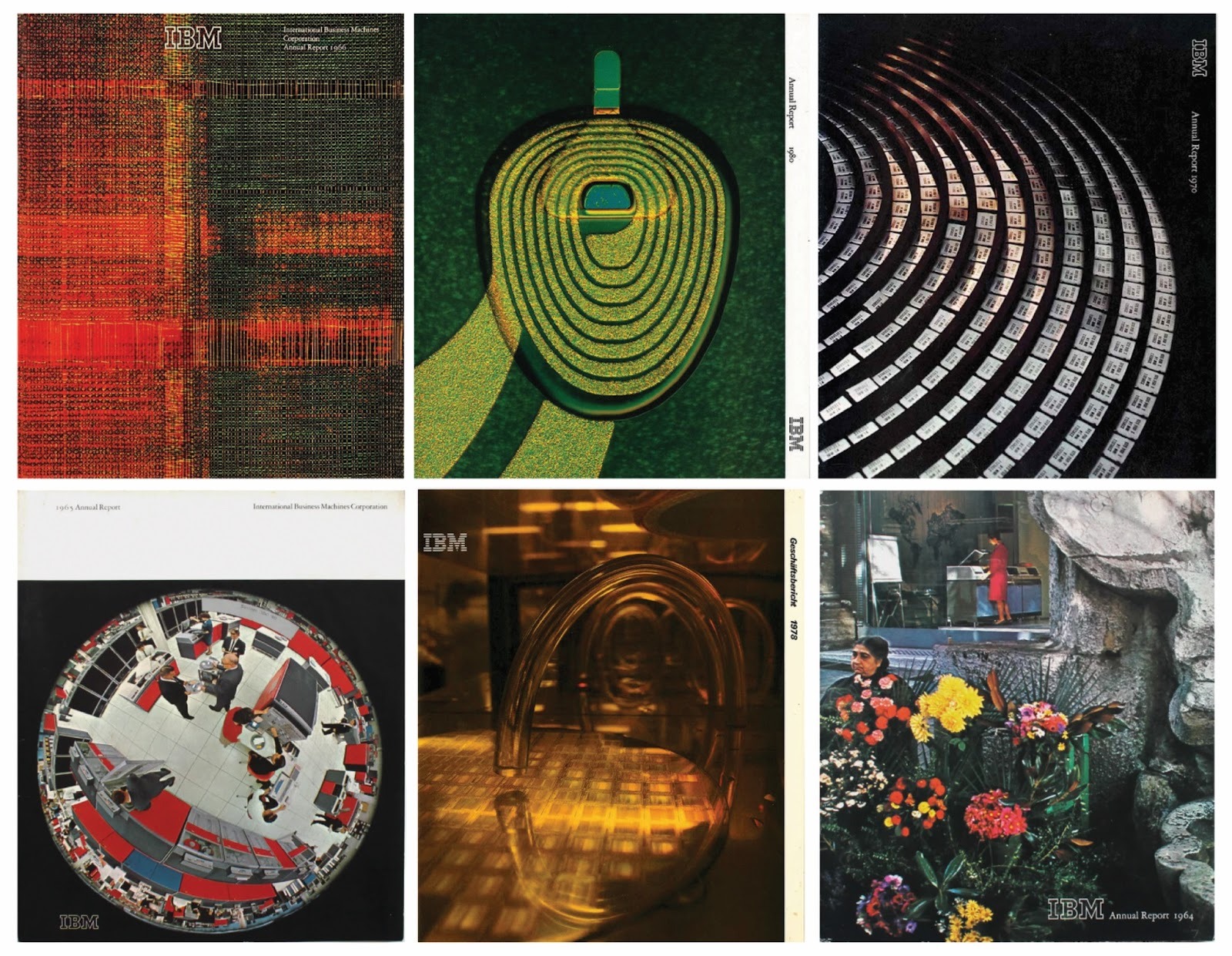
Select reports from IBM, designed by Paul Rand
Three converging forces make the annual report more valuable today than at any point since Buffett started writing.
The first is that accountability has become the scarcest resource in corporate communication. The modern “communications department” has skillfully separated founders from any writing, and AI is driving the marginal cost of producing text to near zero. We’re awash in a trove of competent but undifferentiated corporate writing, with the ‘Era of Belief’ companies willing to be judged publicly just a distant memory. The annual report cuts through this haze because it bears a date, covers a defined period, and makes claims that the following year’s report will either validate or contradict. Crucially: where the endless social media feed makes this dated accountability difficult if not impossible, these reports will sit on a shelf side by side.
Annual report writing also has a unique shot at honesty. Farrell and Gibbons demonstrated in the American Economic Review that a sender who would lie to any single audience in private may tell the truth when multiple audiences are listening simultaneously, because the conflicting incentives to mislead each group cancel each other out. The report activates this discipline because it is addressed to investors, employees, customers, and competitors at the same time. A CEO talking privately to investors has an incentive to be optimistic. A CEO talking privately to employees has an incentive to emphasize stability. The simultaneity of address is what may produce honesty.
The second is that the annual report is built for a depth the feed is actively eroding. We have written elsewhere about how writing is becoming the operating system of business, how narrative is not a wrapper around the work but the foundation of all work. What does a business stand to lose when it only writes at feed-depth? Memory, complexity, and coherence across audiences are at stake: not through dishonesty but through slow, daily drift—one post at a time. Over time, this drift is indistinguishable from not having believed anything in the first place.
The most beautiful annual reports I found this weekend pic.twitter.com/Zfu4cltlRC
— Oliver ೫ (@Prof_Kalkyl) March 22, 2026
One of our clients, Rubric Labs, writes product specifications so detailed they function as legal documents, feeds them to agents, and wakes up to working products. Amazon institutionalized this two decades ago when Bezos banned PowerPoint and required six-page narrative memos. The annual report sits atop this hierarchy, a master narrative from which internal documents, agent specifications, and investor communications may derive coherence. The unit of analysis is the fiscal year, which means the depth of institutional self-knowledge required to write one well cannot be shortcut by any tool. A blog post can be produced in an afternoon. An annual report is the product of twelve months of paying attention to what your company actually did and what it learned.
The third is self-selection. Consider Dario Amodei’s longform essays on AI safety versus what an Anthropic annual report might feel like. Amodei’s essays are written for a specific audience of researchers, technologists, and the technologically-inclined public—an annual report would fold in the company’s investors, employees, customers, and regulators. In a single document: safety beside revenue, philosophy beside hiring data and customer retention metrics. Anthropic’s safety commitments may seem more credible because multiple audiences are listening simultaneously and the company knows it.
People do not trust corporate algorithmic social media and advertising, but they might trust substantial writing reliably delivered on company letterhead. This is the “Go Direct” idea in true form: those who read a five-thousand-word annual report are who you actually want reading it, and it might end up changing the reader. The annual report not only finds your audience, it also constructs it.
An annual report does three things: articulates purpose, records the year, and expresses a mood and worldview. Over time, those things compound.
These days, text is cheap. What’s valuable is belief, memory, and knowledge, transmuted through text and image, placed in relationship by a document, and made accountable to public eyes.
A single report is that document, and then a decade of them is an archive. One that no competitor can fabricate retroactively, and that will determine how future systems understand your business.
Beyond asking if you can afford to produce one, consider: can you afford to let your business be understood by the scattered remnants of content marketing?
Write an annual report. Make it beautiful.